
Shaft Seals, Cutlass Bearings & Engine Service, 14m Trawler-Style Motor Yacht
A main engine and gearbox service on a trawler-style motor yacht, booked while she was out of the water for antifouling. A look over the running gear turned it into a bigger job: both propeller shafts out, two new PSS shaft seals, four new cutlass bearings and, found on the bench during the service, two raw water pumps with failed seals and bearings. She goes back in the water with the lot renewed.
Three weeks on the stands
-
01
Week one
Running gear inspected
Anodes and shaft seals checked, 2-inch PSS seals quoted on the measurement we could take, bearings flagged from video but left for the next slip.
-
02
Week one
Both shafts out
The port shaft showed a worn bearing and a seized grub screw; the starboard propeller had to come off for the coupling tool. All four bearings approved.
-
03
Week two
Shafts measured, bearings renewed
Both shafts cleaned and within tolerance, four new cutlass bearings pressed in, new PSS seals fitted with compression left for coupling day.
-
04
Week two
Engine service
Heat exchangers acid bathed, coolant and impellers renewed, valve lash checked at top dead centre and within the manufacturer's figures.
-
05
Week three
Raw water pumps replaced
A weekend bench test showed water past both mechanical seals and rough bearings; two new pumps fitted in Soft Seal, old ones boxed for the owner.
-
06
Week three
Coupled, Propspeed, relaunched
Couplings torqued with Loctite and anti-seize, Harbour Force applied the Propspeed, final torque and seal compression set, booked for the Friday lift.
The owner of a 14m trawler-style motor yacht, who lives interstate and keeps her on the Gold Coast, had her hauled out at Gold Coast City Marina for antifouling and booked us for the main engine and gearbox service at the same time. She runs a pair of Cummins QSB5.9 diesels on 2-inch shafts, cruises at 7 to 11 knots and will do 22 flat out.
With her on the stands, two of our engineers went over the running gear before anything was ordered. The anodes needed replacing, and Harbour Force took those on with the antifoul. The shaft seals were due. We were certain they were 2-inch PSS seals, but the bellows had been bonded to the stern tubes with Sikaflex and the layout left no way to measure the tube with the seal in place, so we quoted on the measurement we could take and told the owner we would check it again with the old seal off before ordering. The quote was accepted the next morning.
Short videos of the cutlass bearings showed tearing in the rubber. We set out the two paths in writing: seals only means the shafts come off the gearboxes and slide aft, while bearings mean the propellers come off first and the shafts come right out. The owner knew about play in the port side, the starboard had been done within the last couple of years, and the plan was to leave the bearings for the next slip and stay within budget.
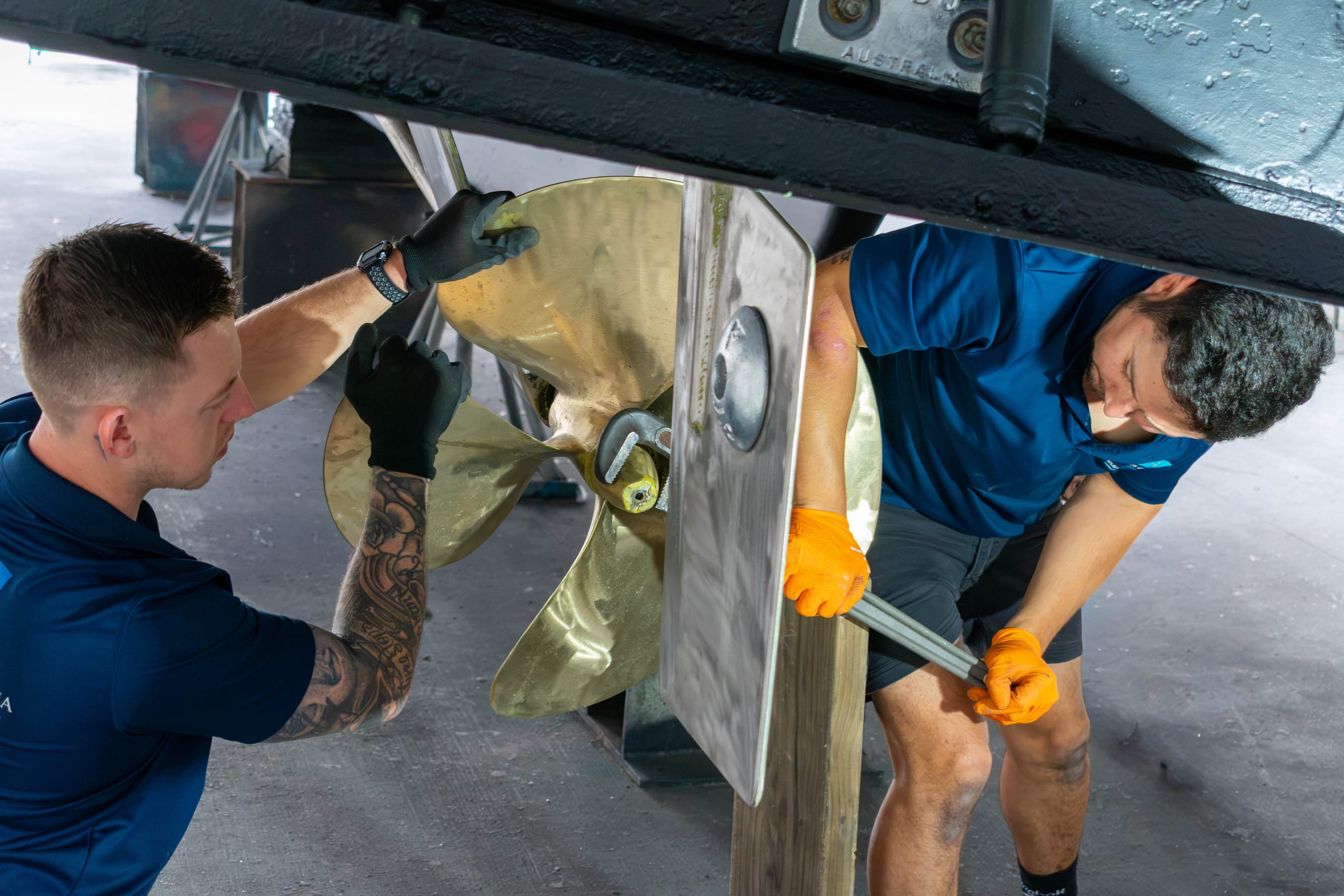
The port shaft came out first, and what it showed changed the plan. The forward bearing was badly worn and one of the grub screws holding it had a stripped head and was seized in the housing. On the starboard side we had intended to leave the propeller on, but there was not enough clearance for the coupling removal tool, so that propeller came off as well and a quick inspection put the starboard bearings in the same state. The owner looked at the photos and approved all four.
There is no winch for this part. A propeller shaft comes out of a motor yacht by hand, two engineers walking it aft through the strut with the rudders masked for the antifoul. Both shafts went to the bench, were cleaned and measured. Each showed light surface marks where it ran through the bearings and both were within tolerance for a 2-inch shaft, so neither needed replacing. The port shaft also carried marks from the grub screws on its forward bearing section, which is unusual and worth recording for next time.
All four bearings came out, two from the struts and two from the stern tubes. The seized grub screw gave way to slow, local heat. The housings were cleaned and treated before the new bearings were pressed in, and the new PSS seals went on with the final compression left until the shafts were coupled up again.
While the shafts were out, the engine service ran alongside. The heat exchangers came off for an acid bath, with roughly 30 litres of coolant drawn from the port engine alone and found clean, with no sign of contamination. The impellers told two stories: the port one was long overdue, the starboard had been changed within the last year or two. Valve lash was checked on every intake and exhaust valve at top dead centre and all of it fell within the manufacturer's figures.
The raw water pumps were the surprise. With the impellers out, we stood both pumps upright on the bench over a weekend with water sitting in the impeller housings. On Monday it had leaked past the mechanical seal on both, and neither shaft turned smoothly on its bearings. We put the photos and the finding to the owner, who approved two new pumps the same morning. They went on sealed in two coats of Soft Seal, and the old pumps were boxed, labelled and left aboard with the impellers we had replaced.
The last days were a sequence with the yard. The couplings went back on with the right torque, Loctite on the threads, anti-seize on the tapers and the locking bolts fitted, then Harbour Force applied the Propspeed to the propellers and shafts. Once that had cured we returned for the final torque on the coupling bolts and set the compression on the shaft seals. She was booked for the Friday lift, three weeks after the first inspection, with the owner flying in with crew for the passage south.
Services rendered
From the project
Related services

Have a similar project in mind?
Tell us about your vessel and what you want done. We’ll define the scope, quote the work and manage it through to handover.